
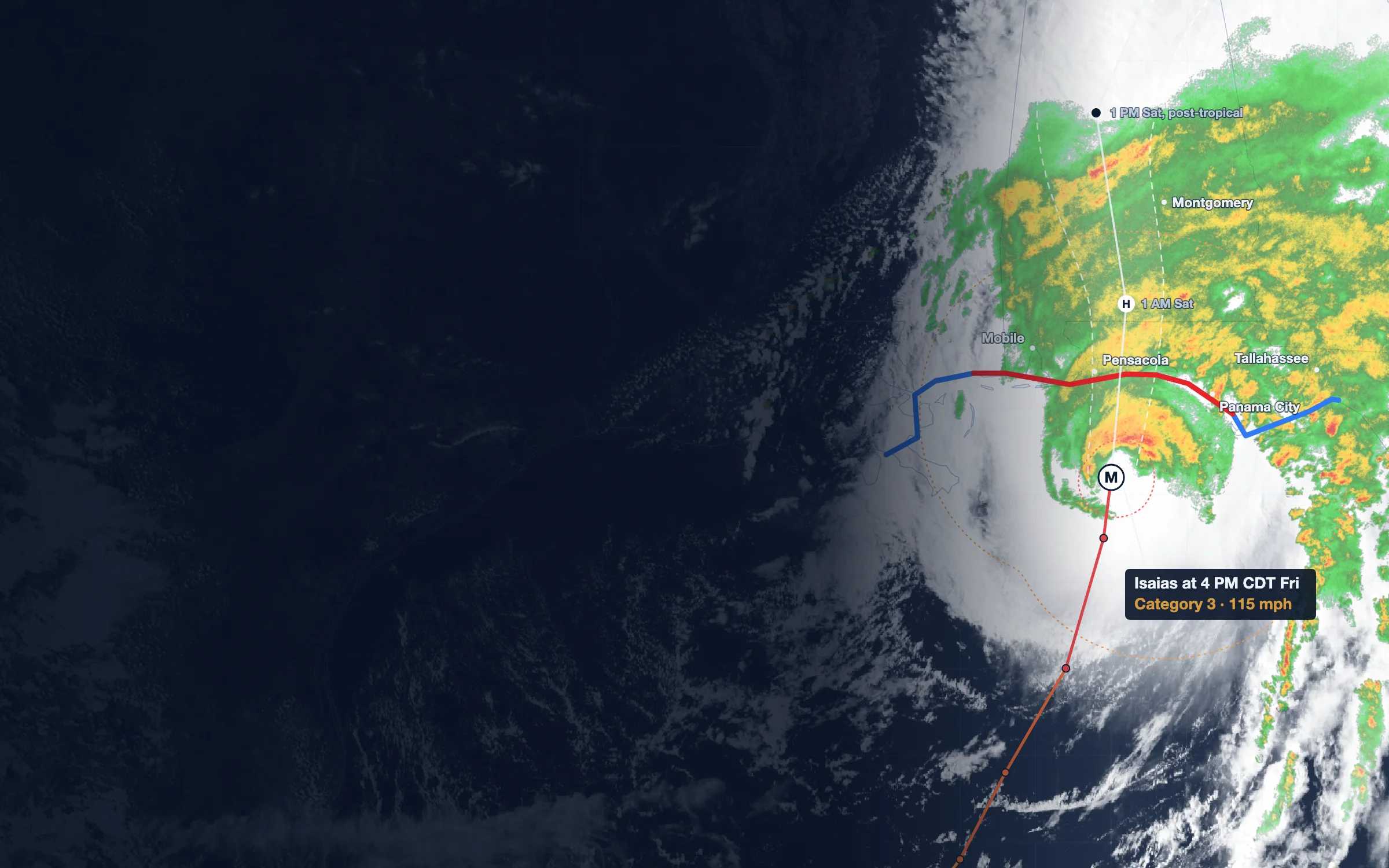
Hurricane Isaias was forecast to come ashore on the evening of October 9, 2026, on the western Florida Panhandle near the Alabama line, with a hurricane warning from coastal Mississippi to the Florida Panhandle. If the storm leaves your home unlivable, your homeowners policy may pay for somewhere to stay while it is repaired. 1st Choice Living has placed furnished travel trailers on homeowners’ own property, nationwide, since 2004. We bill the carrier directly under ALE where the claim covers it, and you have one named contact from the first call to pickup.
Storm facts as of October 9, 2026, 5 p.m. CDT
- The storm. In its 4 p.m. CDT advisory on October 9, 2026, the National Hurricane Center said Isaias was a Category 3 hurricane with maximum sustained winds near 115 mph, and that it was forecast to make landfall along the coast of the western Florida Panhandle that evening and then move across Alabama. Source
- Warnings. That advisory had a hurricane warning in effect from Ocean Springs, Mississippi, to the Bay and Gulf County line in Florida, and said storm surge could reach 6 to 9 feet above ground from the Alabama and Florida border to Grayton Beach, Florida. Source
- Alabama. Governor Kay Ivey declared a state of emergency for 40 Alabama counties, effective 4 p.m. CDT on October 7, 2026. On October 8 she ordered non-residents, tourists, and visitors to leave Baldwin County south of the Gulf Intracoastal Waterway, including Gulf Shores and Orange Beach, and Zone 1 in Mobile County, including Dauphin Island. Source
- Florida. Governor Ron DeSantis declared a state of emergency on October 6, 2026, in Executive Order 26-202, and on October 7 extended it to 27 counties in Executive Order 26-211, including Escambia, Santa Rosa, Okaloosa, Walton, and Bay. Source
- Mississippi. The Mississippi Emergency Management Agency said on October 9, 2026, that parts of Jackson County were under a hurricane warning and that shelters and safe rooms were open in George, Hancock, Harrison, Jackson, and Pearl River counties. We did not find a statewide emergency order on an official Mississippi page as of this update. Source
Conditions change by the hour. For the current forecast and warnings, go to the National Hurricane Center and your local officials.
Safety first
Housing can wait until everyone is safe. Return to your property only when local officials say it is safe to go back. Stay out of flood water, keep clear of downed lines, and do not climb on a damaged roof. Your county emergency management office has the word on roads, shelters, and re-entry:
- Alabama: the Alabama Emergency Management Agency and Ready Alabama.
- Mississippi: the Mississippi Emergency Management Agency and its list of shelters and safe rooms.
- Florida: the county emergency management contacts from the Florida Division of Emergency Management.
When it is safe, photograph everything before anything is cleaned up or thrown out: the roof from the ground, every room with a wet ceiling, every window. For a record of the roof you should not climb on, LossMap documents storm damage by drone before cleanup.
Open the claim and ask about Additional Living Expenses
Additional Living Expenses, or ALE, sometimes called loss of use, pays for somewhere to live while the house is not livable. Ask your carrier whether your policy includes it and what the limit is. That answer decides how your housing gets paid for. Here is how each state’s insurance regulator explains it:
- Alabama. The Alabama Department of Insurance explains that additional living expenses reimburse the cost of your additional living arrangements, and it lists a trailer alongside a hotel or an apartment. It says you will need all receipts to be reimbursed. More on our Alabama page.
- Mississippi. The Mississippi Insurance Department explains that additional living expenses coverage will pay for you to move somewhere temporarily when you cannot live in your home because of damage your policy covers, and it advises you to ask your insurance company early whether you have that coverage. More on our Mississippi page.
- Florida. The Florida Department of Financial Services explains that the additional living expense feature of most homeowners policies pays some expenses for losses that leave homes unlivable during repairs, and to keep all receipts. Its Insurance Consumer Helpline is 1-877-693-5236. More on our Florida page.
Flood is different. National Flood Insurance Program policies do not provide additional living expense coverage. If your home also had damage your homeowners policy covers, such as wind, ask your adjuster how ALE applies. This is general information, not legal or coverage advice. Your policy and your adjuster decide what is covered.
Ask about a trailer on your lot
Call or send the request form. Send us your claim number, your adjuster’s contact, and the property address. We confirm the local rules and set up a furnished unit on your property.
Hotel, rental, or a trailer on your own lot
There are three real options, and the right answer depends on your family, your property, and how the rebuild is likely to go.
- Hotel. The easiest first night, and often where the carrier puts you at the start. Rooms are small, there is no kitchen, and restaurant meals add up against your ALE limit.
- Rental house or apartment. More room and a kitchen. After a large storm, rentals near your home go first, and a lease may not match the rebuild. You can end up farther from your neighborhood, your kids’ school, and your job than you want to be.
- A travel trailer on your own property. A furnished unit delivered, leveled, and connected on your own lot. You stay next to the rebuild, so you are there when the adjuster and the roofer show up. Kids stay in their school and pets stay home. It needs room on the lot and local rules that allow a temporary RV during a rebuild, which is why we check first. If it is not the right fit for your property, we will tell you.
When a whole town is hit, the hotels fill and the rentals go. On-site placement does not compete for any of that. The trailer goes on ground you already own.
How a trailer on your lot works with your ALE
- Local rules for your address checked before delivery.
- A furnished travel trailer that sleeps 2 to 10, with a kitchen, a bathroom, real beds, and heat and air, delivered, leveled, and set up on your property.
- Utilities connected by licensed, insured contractors from our preferred vendor network, planned around what is actually working at the property.
- Site conditions documented at setup and again at takedown.
- Direct billing to your carrier under ALE where the claim covers it, tracked against your ALE limit. On a covered claim that is $0 out of pocket for your family.
- One named contact from the first call to the day the unit leaves.
The full walkthrough is on our on-site RV housing page, and our after a storm guide covers roof claims and the questions to ask your adjuster.
Already working with a temporary housing company?
Many carriers send ALE housing through a temporary housing company. We work with any temporary housing company. If one is handling your housing, ask them to place you with 1st Choice Living for a trailer on your own lot. They send us the placement, we deliver, set up, and service the trailer, and the billing runs through them or straight to your carrier, whichever way their program works. Housing companies can see how we work as their on-site vendor.
Local rules in Alabama, Mississippi, and Florida
Florida has a statewide rule. Under section 125.023 (counties) and section 166.0335 (cities), Florida Statutes, after the Governor declares a state of emergency for a natural emergency, a county or city may not prohibit one temporary shelter, such as a recreational vehicle or trailer, on residential property where the home was made uninhabitable. It can stay up to 36 months or until a certificate of occupancy is issued, when you are making a good faith effort to rebuild, utilities are connected, and you live in it.
Alabama and Mississippi leave it to the city or county. We did not find a statewide rule in either state, and rules in town can be very different from rules in the country. We check your local rules before delivery.
Isaias pages by area
Each area page has the local rule on a trailer on your lot, quoted from the official city or county source, or a plain “check with the city or county” where we did not find one, plus the permit offices and county emergency management links. All of them side by side: Hurricane Isaias RV rules by county.
- Alabama: Mobile and Mobile County, Baldwin County
- Inland Alabama: Brewton and Atmore (Escambia County, AL), Andalusia (Covington County), Dothan and Enterprise (The Wiregrass), Selma (Dallas County), Montgomery area, Tuscaloosa County, Birmingham area
- Mississippi: Gulfport and Biloxi (Harrison County), Pascagoula and Ocean Springs (Jackson County), Hancock County
- Florida: Pensacola and Escambia County, Santa Rosa County, Fort Walton Beach and Destin (Okaloosa County), Panama City (Bay County)
For adjusters and housing companies
If you are handling Isaias files, send the placement the way you would any other: the property address, the household size, the claim number, the ALE limit, and where to send invoices. We check the local rules, confirm the site can take a unit, and schedule delivery with the family. Start at for adjusters and carriers or for housing companies. Independent adjusters deployed on Isaias claims: see for independent adjusters.
More help after Isaias
- Travel trailers for crews and families after Hurricane Isaias from Temporary RV Living, for restoration, roofing, and utility crews, and for families arranging a trailer themselves.
- Drone documentation after Hurricane Isaias from LossMap, to record roof and property damage before cleanup.
- Our state pages for Alabama, Mississippi, and Florida.
Frequently asked questions
Will my homeowners insurance pay for a travel trailer on my property after Hurricane Isaias?
Many homeowner policies include Additional Living Expenses, also called loss of use, which pays for somewhere to live while the house is not livable. The Alabama Department of Insurance lists a trailer alongside a hotel or an apartment. Whether your policy includes it, and what the limit is, is a question for your adjuster. When the claim covers it, we bill the carrier directly and a covered claim is $0 out of pocket for you.
When can I go back to my property?
Only when local officials say it is safe. Follow your county emergency management office, stay out of flood water, and do not climb on a damaged roof. We check the local rules for your address before delivery, and setup is planned around what is actually safe and working at the property.
Can I live in a travel trailer on my own lot in Florida after Isaias?
Florida law says that after a Governor's emergency declaration, a county or city may not prohibit one temporary shelter, including an RV, on a residential lot where the home was made uninhabitable, if you are making a good faith effort to rebuild, the unit is connected to water and electric, and you live in it. It can stay up to 36 months or until a certificate of occupancy is issued.
What about Alabama and Mississippi?
We did not find a statewide rule in either state on living in a travel trailer on your own lot while you rebuild. It is set by your city or county, and we check the local requirements for your address before delivery.
Does flood insurance pay for temporary housing?
National Flood Insurance Program policies do not provide additional living expense coverage, and Florida's Department of Financial Services says the ALE feature does not apply to flood insurance. If your home also had damage your homeowners policy covers, such as wind, ask your adjuster how ALE applies.
A temporary housing company is handling my housing. Can I still get a trailer from you?
Yes. We work with any temporary housing company. Ask the company handling your housing to place you with 1st Choice Living for a trailer on your own lot. They send us the placement, we deliver, set up, and service the trailer, and the billing runs the way their program is set up.
I am an adjuster or a housing company. How do I send a placement?
Call us or send the request form with the property address, how many people are in the household, the claim number, the ALE limit, and where to send invoices. From there we check the local rules on a temporary RV at that address, confirm the site can take a unit, and schedule delivery with the family. You get one named contact from the first call to pickup.
Stay on your lot while the house is repaired
Call or send the request form. One named contact, local rules checked before delivery, direct billing to your carrier where the claim covers it.
Adjuster or housing company? Send a placement.
Sources, checked October 9, 2026, 5 p.m. CDT
- https://www.nhc.noaa.gov/archive/2026/al09/al092026.public.013.shtml
- https://governor.alabama.gov/newsroom/2026/10/governor-ivey-urges-alabamians-to-prepare-for-hurricane-isaias-provides-update/
- https://governor.alabama.gov/wp-content/uploads/2026/10/10-07-2026-SOE-Isaias.pdf
- https://governor.alabama.gov/wp-content/uploads/2026/10/2026-10-08-SOE-First-Supplemental-Hurricane-Isaias.pdf
- https://www.flgov.com/eog/news/press/2026/governor-ron-desantis-issues-updates-state-preparedness-efforts-hurricane-isaias-0
- https://www.flgov.com/eog/sites/default/files/executive-orders/2026/EO%2026-202.pdf
- https://www.flgov.com/eog/sites/default/files/executive-orders/2026/EO%2026-211.pdf
- https://www.msema.org/news/mississippi-residents-urged-remain-alert-hurricane-isaias-approaches-shelters-open-multiple
- https://aldoi.gov/PDF/Consumers/NaturalDisastersGuide.pdf
- https://www.mid.ms.gov/mississippi-insurance-department/consumers/homeowners-insurance-2/
- https://myfloridacfo.com/division/consumers/storm
- http://www.leg.state.fl.us/statutes/index.cfm?App_mode=Display_Statute&URL=0100-0199/0125/Sections/0125.023.html