
If you are reading this, the fire is out and you are trying to work out where your family sleeps next. This guide covers the first 72 hours, what Additional Living Expenses actually pay for, the three real housing options, and the questions worth asking your adjuster. 1st Choice Living has placed displaced families since 2004, and most of what follows is what we tell people on the first call.
The first 72 hours
Do not go back inside until the fire department says the structure is safe. Smoke, weakened floors, and electrical damage are not always visible from the doorway. If the department clears you to retrieve items, go in with a flashlight and take only what you need: medications, IDs, glasses, phones and chargers, a change of clothes, and important documents.
Ask the fire department for the incident or fire report number before they leave. Your insurance carrier will ask for it, and it is much easier to get now than later.
Call your carrier as soon as you are able. The claims line is on your insurance card or the declarations page. Tell them the home is uninhabitable and ask two things directly: does my policy include Additional Living Expenses, and what is my limit. Write down the claim number and the adjuster’s name.
From this point, keep every receipt. Hotel nights, meals, replacement clothing, pet boarding, mileage to and from the property, laundry, and anything else you paid for because you could not go home. A folder or a photo album on your phone works fine.
First 72 hours checklist
- Confirm everyone is accounted for and get checked for smoke exposure.
- Get the fire report number from the department.
- Call the carrier, open the claim, and ask about Additional Living Expenses.
- Ask who is securing the property, and whether board-up or tarping is covered.
- Photograph the damage from the outside before anything is moved. Aerial documentation from LossMap captures the roof and the whole lot from the air.
- Notify your mortgage lender and the utility companies.
- Start a receipts folder and put every receipt in it.
- Tell your kids’ school and your employer what happened.
What Additional Living Expenses actually cover
Additional Living Expenses, usually shortened to ALE and sometimes called loss of use, is the part of a homeowner’s policy that pays the extra cost of living somewhere else while your home is unlivable because of a covered loss. The key word is extra. ALE covers the difference between what you normally spend and what you are spending now because of the fire.
In practice that usually means:
- Hotel or motel nights.
- Rent on a house or apartment.
- Meals above what you would normally spend on groceries.
- A furnished travel trailer placed on your own property.
- Related costs such as laundry, storage, pet boarding, and extra mileage.
It does not pay your mortgage, and it does not pay for things you would have bought anyway.
Limits work in one of two ways. Some policies cap ALE at a percentage of your dwelling coverage. Others cap it at a length of time. Some do both. Policies vary a lot, and the only person who can confirm your numbers is your adjuster. Ask for the limit in writing and keep it. Every housing decision you make from here should fit inside it.
Hotel, rental, or stay on your property
There are three real options. Each has tradeoffs, and the right answer depends on your family, your property, and how the rebuild is likely to go.
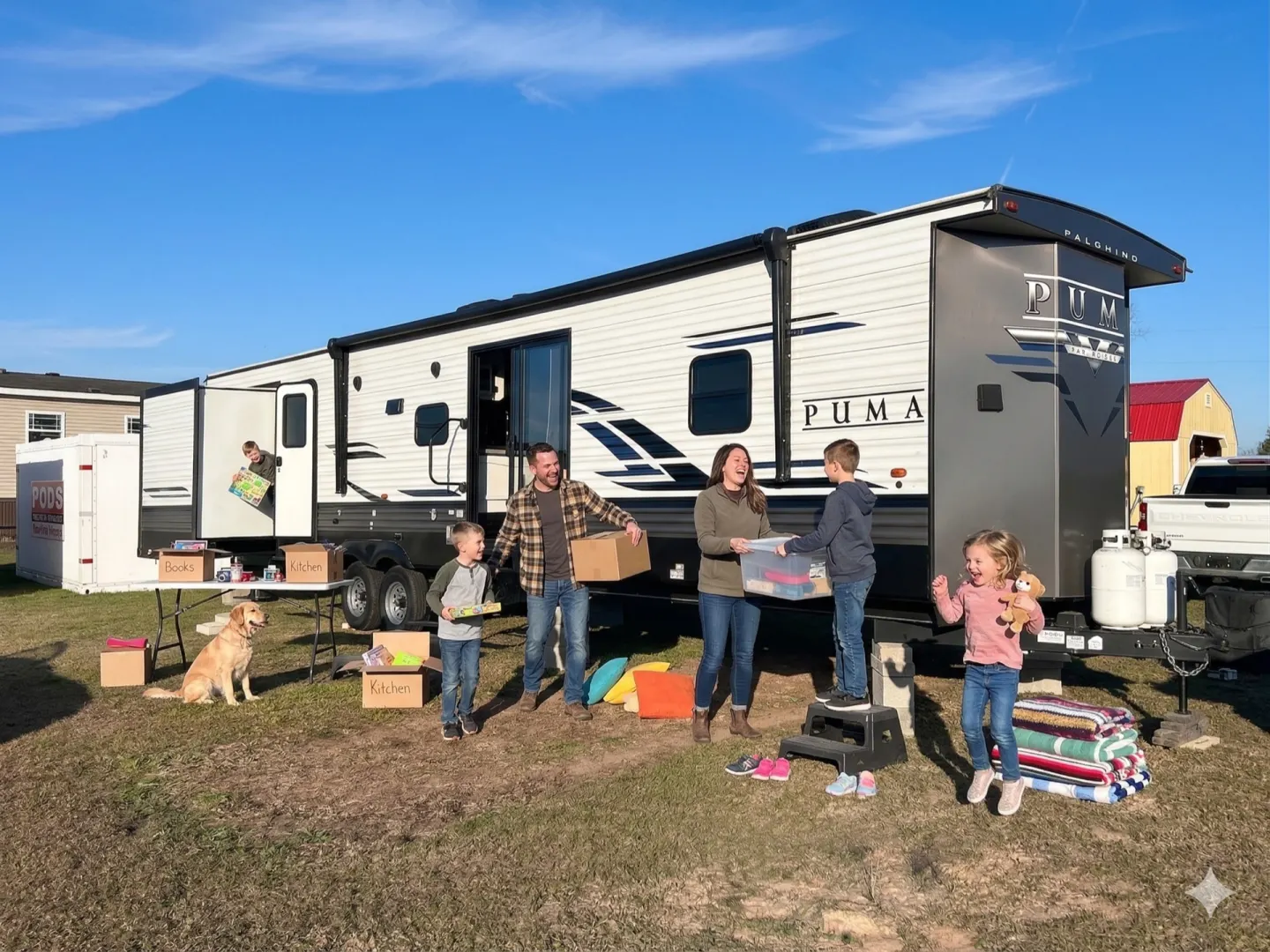
How on-site RV housing works during a claim
Here is what a placement looks like when 1st Choice Living handles it. The full walkthrough is on the on-site RV housing page.
- We check local rules on a temporary RV during a rebuild before delivery. Some places need a temporary-use permit, and we help sort that out.
- A fully furnished travel trailer is delivered, leveled, and set up on your property. Units sleep 2 to 10 and come with a kitchen, a bathroom, real beds, and heat and air.
- Utilities are connected by licensed, insured contractors from our preferred vendor network.
- Site conditions are documented at setup and again at takedown, so there is a clear record for you and the carrier.
- We bill the carrier directly under ALE and track usage against your limit. On a covered claim, that is $0 out of pocket for your family.
- Scheduled service visits keep the unit working while you live in it.
- You have one named contact for the whole stay.
- When the claim closes and you move back in, we pick the unit up.
If you need housewares beyond what comes with the unit, packages from Temporary Housewares cover linens, cookware, and the rest of what burned. Your adjuster can work with us directly. And if you are wondering what living in a travel trailer is actually like day to day, this is an honest look.
How long the rebuild takes
We get asked this on almost every first call, and the honest answer is that it is not ours to promise. The timeline depends on how much of the home was damaged, how the claim is adjusted, how long permitting takes in your city or county, and when your contractor can start and staff the job. Smoke and water damage in one part of a home is a different project from a structure that has to come down.
What we can say is that the housing follows the claim. Whether you are in a hotel, a rental, or a unit on your property, the arrangement should run as long as the rebuild runs and stop when you move home. That is why we track against your ALE limit and stay in touch with your adjuster, so nobody is surprised near the end.
Questions to ask your adjuster
Write the answers down. You will refer back to them more than once.
- Does my policy include Additional Living Expenses, and what is the limit?
- Is the limit a percentage of dwelling coverage, a time cap, or both?
- Can temporary housing be billed directly to the carrier, or do I pay first and submit for reimbursement?
- Will you cover a furnished travel trailer placed on my property under ALE?
- What receipts do you need from me, and how should I submit them?
- Who is securing the property, and is board-up or tarping covered?
- Can I get an advance on ALE or contents coverage for the first days?
- How do I reach you, and who covers when you are out?
- What happens to my housing if the rebuild runs longer than the first estimate?
- Are there exclusions I should know about before I sign a lease or a housing agreement?
FAQ
Can I put a travel trailer on my property after a fire?
Often, yes. Many cities and counties allow a temporary RV on a residential lot during an active rebuild, and some require a temporary-use permit first. Rules vary by jurisdiction, so we check what applies to your address before anything is delivered.
Will my insurance pay for it?
If your policy includes Additional Living Expenses and the fire is a covered loss, a furnished travel trailer on your own property is the kind of housing ALE is meant to cover. Your adjuster confirms coverage and the limit. We bill the carrier directly and track against that limit, so on a covered claim your family pays $0 out of pocket.
What if I rent?
Renters policies often include loss of use coverage. Call your own carrier and ask the same questions a homeowner would. Placing a unit on a rented lot also needs the property owner’s permission. If there is no policy in play, the housing options are the same, but the cost falls to you, and we will be straight with you about that on the first call.
How do I get started?
Call us or request housing through the contact form. We ask about your property, your claim, and your family size, then talk with your adjuster about coverage. You get one named contact from the first call to pickup.
Stay on your property while you rebuild
If your home is uninhabitable and you want to stay on your property, call (214) 493-1515 or request housing. We serve families nationwide, with units staged near you.