
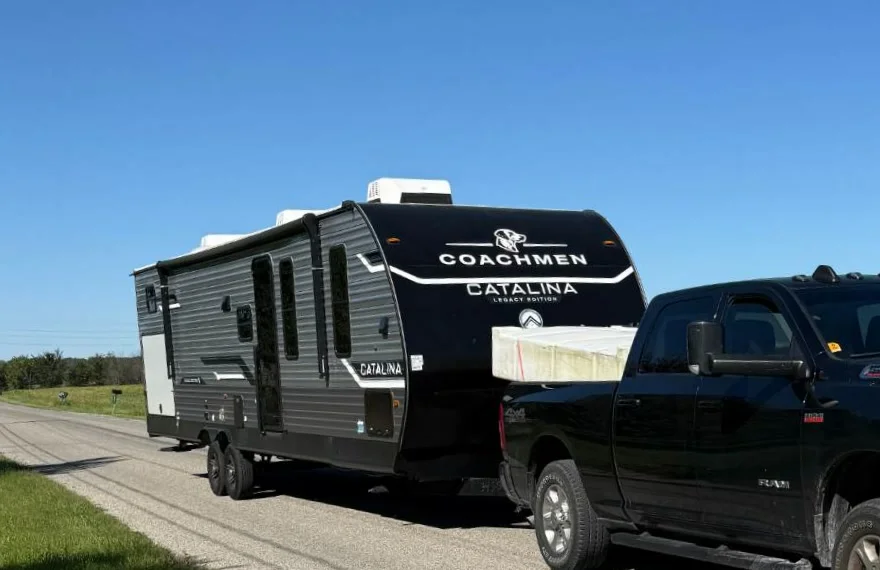
From August 11 through 17, 2026, the National Weather Service office in Indianapolis reports, multiple rounds of thunderstorms brought over a foot of rain to some parts of central Indiana, and the White River at Anderson and Noblesville set new record crests, breaking records from 1913. The Indiana Department of Insurance says that if a peril your homeowners policy covers forces you to move out temporarily, your insurance may pay reasonable additional living expenses. If your adjuster approves it, that coverage can pay for a furnished travel trailer from 1st Choice Living, set up on your own lot while the house is repaired, where the local rules allow it. Families nationwide have lived on site this way with us since 2004.
What Indiana homeowners are recovering from
On the morning and afternoon of August 11, 2026, the Indiana Department of Homeland Security (IDHS) reports, a thunderstorm system that the Storm Prediction Center preliminarily classified as a derecho crossed from Illinois into northwest and north-central Indiana. IDHS says it produced extreme straight-line winds, at least two tornadoes, large hail, and flash flooding, and that repeated rounds of heavy rain followed, with multiple rivers reaching major flood stage.
The National Weather Service office in Indianapolis says a wet pattern from August 11 through 17 brought over a foot of rain to some areas of central Indiana. The White River at Anderson and Noblesville set new record crests, and at Nora it reached its highest level since the record set in 1913.
FEMA declared a major disaster for Indiana, DR-4933-IN, on August 25, 2026, for severe storms, straight-line winds, tornadoes, and flooding from August 11 to 24, 2026. IDHS says homeowners and renters in 24 counties were eligible to apply for FEMA Individual Assistance, and that the deadline to apply was October 25, 2026.
How the Indiana Department of Insurance explains additional living expenses
The Indiana Department of Insurance’s property insurance page says that if your home is damaged by one of the perils covered by your homeowners policy and you are forced to move temporarily into a hotel or motel, your insurance may pay reasonable additional living expenses. Key points from the Department:
- It is a share of your dwelling amount. The Department says additional living expenses, “in case damage makes your home temporarily unlivable,” are set as a percentage of the amount of insurance on your home.
- The percentage can be raised. The Department says those percentages can usually be increased with a minor premium adjustment. That is a question for your agent before the next loss, not during a claim.
- It pays reasonable expenses. The Department’s wording is “reasonable additional living expenses,” so keep every receipt and put the terms of any housing in front of your adjuster.
Your own carrier’s policy form sets the time and dollar limits. We quote them, with the source, on loss of use coverage by insurance carrier, including Erie, which lists homeowners coverage in Indiana. This is general information, not legal or coverage advice. Your policy and your adjuster decide what is covered.
How a trailer on your lot works with your ALE
1st Choice Living bills your carrier directly under ALE where the claim covers it, so there are no lodging receipts for you to submit for the trailer. We track your placement against your ALE limit, so you and your adjuster can see where things stand while the repairs move forward. You have one named contact from the first call to pickup.
Our furnished travel trailers sleep 1 to 10. We deliver, level, and set up the unit on your property, whether that is a city lot or acreage. Utilities are connected by licensed, insured contractors. We document site conditions at setup and takedown, so everyone has a clear record.
Local rules in Indiana are set by your city, town, or county
We did not find an Indiana statute or state rule that allows or limits living in a travel trailer on your own lot while the house is repaired. It is handled by your city, town, or county zoning code, and the rule inside town limits can be very different from the rule in the county.
We check that rule before delivery. If you want a head start, call your city, town, or county planning office and ask about living in a travel trailer during repairs: whether a temporary permit is needed, how long it lasts, and what water, sewer, and power connections the office requires. If a trailer is not allowed at your address, we will tell you, and you can ask your adjuster how ALE applies to a hotel or a furnished rental instead.
Indiana recovery resources to know
The Indiana Department of Homeland Security runs the state’s August 2026 disaster information hub. It also runs the State Disaster Relief Fund, which IDHS says is limited to uninsured damage to eligible items at your primary residence in a jurisdiction that has issued a local disaster declaration. IDHS says Indiana 211 is the main point of contact for the fund: call 866-211-9966 and press 9 for disaster resources.
If your home is in a mapped floodplain, IDHS says local officials must decide whether it is substantially damaged, and that the answer may change what you must meet when you repair or rebuild. Its Substantial Damage Property Assistance Line is 833-495-9888.
For insurance questions, the Indiana Department of Insurance’s Consumer Services line is 800-622-4461, or 317-232-2395.
After the August 2026 storms
Our page on temporary housing after the Indiana and Ohio storms has the storm facts, the FEMA dates, and the local rule on a trailer on your lot for five Indiana areas: Northwest Indiana, Indianapolis and central Indiana, East central Indiana, Southeast Indiana, and North central Indiana.
For crews and agencies working in Indiana
The same furnished units house crews on job sites and support agencies coordinating displaced households. Adjusters get one named contact and a placement tracked against the policy limit.
Frequently asked questions
Will my Indiana homeowners policy pay for a travel trailer on my property?
The Indiana Department of Insurance says that if your home is damaged by a peril your homeowners policy covers and you are forced to move temporarily into a hotel or motel, your insurance may pay reasonable additional living expenses. Your carrier and adjuster decide what is approved, including a trailer on your lot. Where the claim covers it, we bill the carrier directly.
How much ALE does an Indiana policy include?
The Department says additional living expenses, in case damage makes your home temporarily unlivable, are a set percentage of the amount of insurance on your home, and that the percentage can usually be increased with a minor premium adjustment. Your declarations page shows your limit; ask your adjuster about any time limit.
Can I live in a travel trailer on my own lot in Indiana?
It depends on your city, town, or county. We did not find an Indiana statute or state rule that allows or limits it after a disaster, so the local zoning code decides. We check the rule for your address before delivery.
Can I still apply for FEMA help after the August 2026 storms?
The Indiana Department of Homeland Security says the deadline to apply for FEMA Individual Assistance was October 25, 2026, and that households who applied will keep seeing updates on their applications. For uninsured damage at a primary residence, IDHS points survivors to the State Disaster Relief Fund through Indiana 211 at 866-211-9966.
My home is in a floodplain. Can that change the repairs?
It can. IDHS says local officials must assess damaged structures in mapped flood hazard areas for substantial damage, generally when the cost to restore a structure equals or exceeds 50 percent of its pre-damage market value, and that a determination may affect what you must meet when repairing or rebuilding. Its Substantial Damage Property Assistance Line is 833-495-9888.
Get started
Send us your claim number, your adjuster's contact, and the property address. We confirm the local rule first, then set up a furnished unit on your property.
Want the details on placement first? Read about on-site RV housing.
Sources